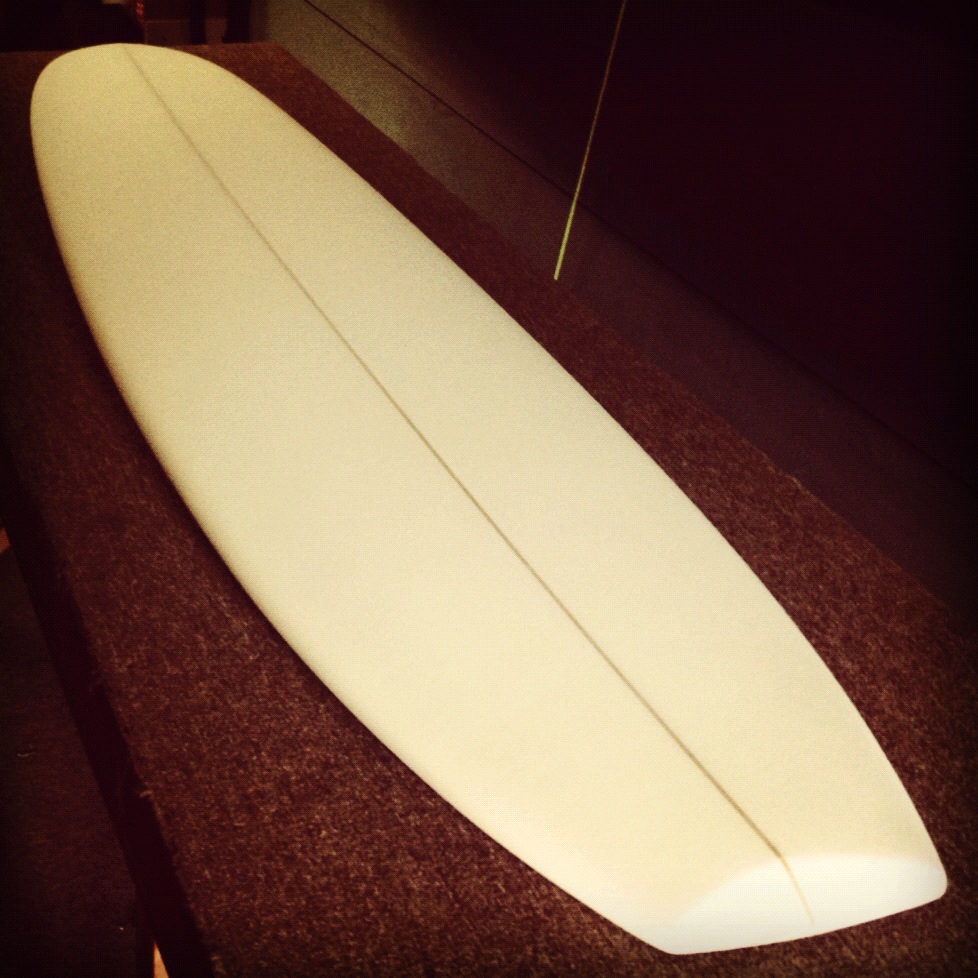
Alright folks, time for a little history lesson. For those of you who love the risingly popular mini-simmons style boards, sit back and take a few notes, here's where they came from. Hailing from Los Angeles, Bob Simmons ran into quite a few health problems early on, with doctors diagnosing a tumor in his ankle, saying he'd need to have it amputated. Not pleased with the doctor's opinions, his mother went to an alternative practitioner, who suggested a healthy and rigorous diet. As Simmons adhered to the diet, he rode his bicycle to strengthen his legs. Tragedy would strike again, however, in the form of a car accident. Simmons was hit by a car and was hospitalized with a broken leg, a broken elbow, and a fractured skull. While his head and his leg healed, his arm was wired together loosely and wasn't at full strength. He was suggested surfing as physical therapy, and began paddling one of Tom Blake's paddleboards. Due to his physical state, Simmons struggled with the heavy, 75-100 pound, redwood boards of the era. As it were, necessity is the mother of all creativity. Simmons had a degree in engineering from Cal Tech and worked as a mathematician for Douglas Aircraft. He began to apply the principals of hydrodynamic theory (which is very similar to aerodynamic theory) to his surfboard designs, and began experimenting with the new space age materials of the time, styrofoam and fiberglass. Simmons created some of the first "sandwich" construction surfboards, drastically reducing the weight and opening the door for the lightweight balsa longboard. Simmons experimented with other aspects of design that are now considered commonplace, such as concave, aspect ratios, board weight, rocker and nose kick, the twin fin, and more. Gordie Duane and Bob Simmons worked together on many of these boards, calling them "maxi-simms". Steve, having shaped for years with Gordie, crafted this beauty of a surfboard in similar fashion, adhering to the same principals that Bob Simmons used on his designs. EPS foam (styrofoam) and epoxy resin, spoon nose with plenty of kick, glassed on twin fins, and a wide, maneuverable tail. Steve's replica measures out at 10'6" x 25 1/2" x 3 3/4", and is on it's way to Japan for one very happy customer.